

The Nursery of the Reef
Lac Bay on Bonaire’s windward (eastern) coast contains one of the most significant mangrove ecosystems in the Caribbean — a fringing mangrove forest that functions as the nursery for the reef. Juvenile fish, crabs, shrimp, and other marine organisms spend their early life stages in the sheltered, nutrient-rich water among the mangrove roots before migrating to the reef as adults. The mangroves also protect the coastline from erosion, filter sediment from the water, and sequester carbon at a rate higher than most terrestrial forests.
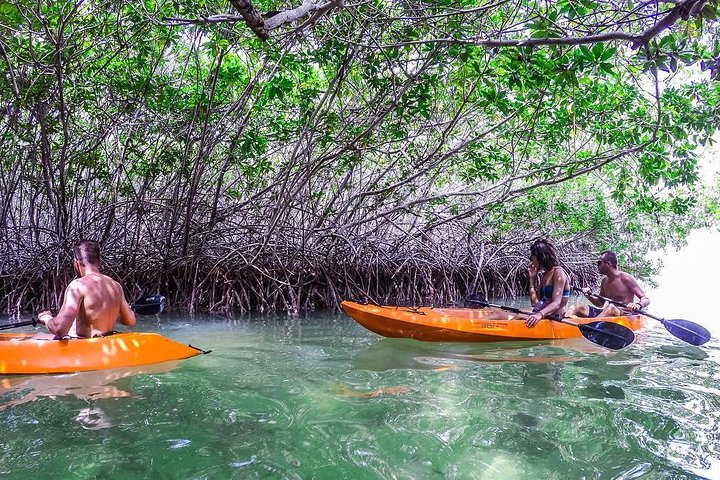
A mangrove tour explores this ecosystem by kayak or small boat — paddling through the mangrove channels, observing the juvenile marine life in the root systems, spotting birds (herons, pelicans, and occasionally flamingos in the bay’s shallows), and learning the ecological connections between the mangrove, the seagrass beds, and the reef that together form Bonaire’s interconnected marine ecosystem.
What You Will See
Red mangroves (Rhizophora mangle) — the primary mangrove species at Lac Bay, with their distinctive prop roots extending from the trunk into the water. The root systems create a dense underwater network that provides shelter for juvenile fish, sponges, tunicates, and algae.
Upside-down jellyfish (Cassiopea) — found on the sandy bottom of the mangrove channels, these jellyfish rest bell-down on the seabed, their tentacles facing upward to maximise sunlight exposure for their symbiotic algae. They are not aggressively stinging but can irritate sensitive skin.
Juvenile fish — parrotfish, snapper, barracuda, and other reef species in their early, small stages, using the mangrove roots as shelter from predators.
Bird life — yellow-crowned night herons, green herons, brown pelicans, and the magnificent frigatebird are common in the mangrove fringe.
Practical Tips
Kayak tours are the best format. The mangrove channels are narrow and shallow — motorised boats cannot access the inner mangrove, and kayaks provide the silent, low-impact approach that avoids disturbing the wildlife and the ecosystem.
A guide is essential. The mangrove channels are confusing (the routes look alike), the ecological interpretation requires specialist knowledge, and the guide manages the group’s impact on the sensitive environment.
Bring insect repellent. Mangrove environments harbour mosquitoes and sandflies (no-see-ums). Apply repellent before the tour. Long sleeves and trousers help.
Morning tours are calmest. Lac Bay is exposed to the trade winds, which build through the day. Morning tours (departing 8:00–9:00 AM) enjoy the calmest paddling conditions.
Frequently Asked Questions
How long is a mangrove kayak tour?
Typically 2–3 hours including paddling through the channels, ecological interpretation stops, and often a snorkelling or swimming stop in Lac Bay afterward.
Is the mangrove tour physically demanding?
Light to moderate. The paddling is gentle (the channels are sheltered and flat), the distances are short (2–4 kilometres), and the guide manages the pace. Basic fitness and comfort in a kayak are sufficient.
Why are the mangroves important?
The mangroves are the nursery for Bonaire’s reef — juvenile fish shelter in the root systems before migrating to the coral reef as adults. Without the mangroves, the reef’s fish populations would decline. The mangroves also protect the coastline, filter sediment, and store carbon. Protecting Lac Bay’s mangroves is directly connected to protecting the reef.